I served as the primary researcher on a collaborative effort with L3Harris Technologies to improve the user effectiveness of their critical computer systems. We established scientifically grounded interaction design guidelines, and we created new methods and interaction paradigms where the state of the science guidelines fall short. This project involved detailed research to understand the task and users, collaborating with Product Managers and Engineering Teams to identify best practices, and the prototyping interfaces for user testing.
Project Title
Critical Human Machine Interaction in Op Centers
Optimizing for Crisis Assessments, Operator Performance, and Stress Effects
A collaboration between L3Harris Technologies and The Applied Cognitive Science Lab at Penn State University.

Points of contact
- Mark Foster, Ph.D., Chief Engineer at L3Harris Technologies
- James E Ringrose, Senior Scientist at L3Harris Technologies
- Professor Frank Ritter, Ph.D., Director of the Applied Cognitive Science Lab at Penn State
Project Date
December 2017 through August 2019
Role(s) and Responsibilities
I served as the primary researcher and designer for this project working under the management of Dr. Frank Ritter. This project had several phases with different responsibilities which I describe below.
Phase 1: Researcher for Best Practices in User-Centered Design
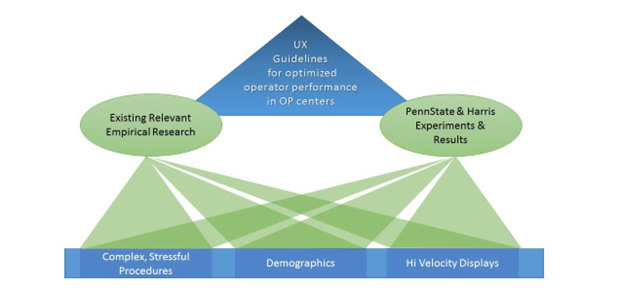
The first task was to conduct a deep literature review of the research on user-centered design and become the subject-matter expert for this project. I built a library of important research articles and other information that were directly relevant to the goal of building better interfaces for high-stakes tasks. I met with stakeholders at L3Harris weekly to share progress, identify new avenues for exploration, and to collaborate on setting useful goals for the project.
After this project completed, I collaborated with Professor Frank Ritter to publish our findings. This literature review was revised into a book on how to design better interfaces and published with Springer as Building Better Interfaces for Remote Autonomous Systems: An Introduction for Systems Engineers by Jacob D. Oury and Frank E. Ritter.
Phase 2: User Interface Designer and Tester
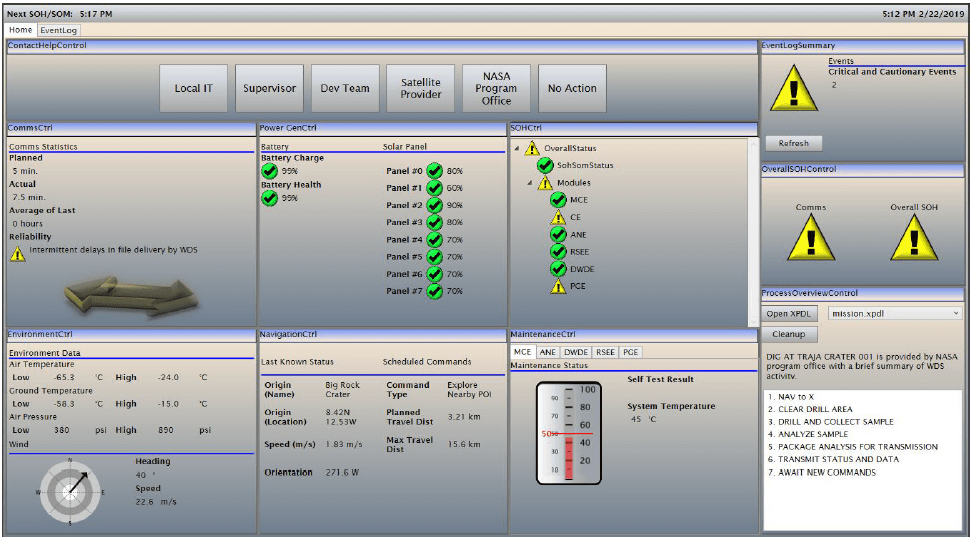
After completing the literature review, my next task was to design three test interface prototypes that demonstrate three different approaches for the design of the Mars Rover Dashboard Interface. These interfaces would then be used in a series of user tests to test how different design patterns and interaction styles affect the task performance.
Prior to designing the interfaces, I conducted a hierarchical task analysis to understand the procedures, tasks, and subtasks that users complete with this system. The task analysis provided a checklist for ensuring that the proposed interface designs meet the functional requirements.
The first design was a recreation of their current design reworked to fit the test scenarios. L3Harris Technologies has an in-house style for their dashboard interfaces that was designed to meet the needs of the developers and engineers that build these systems. They did not design this system with consideration towards best practices in UX, and they were looking to understand how the current design compares to a new design scheme that accounts for the latest UX research.
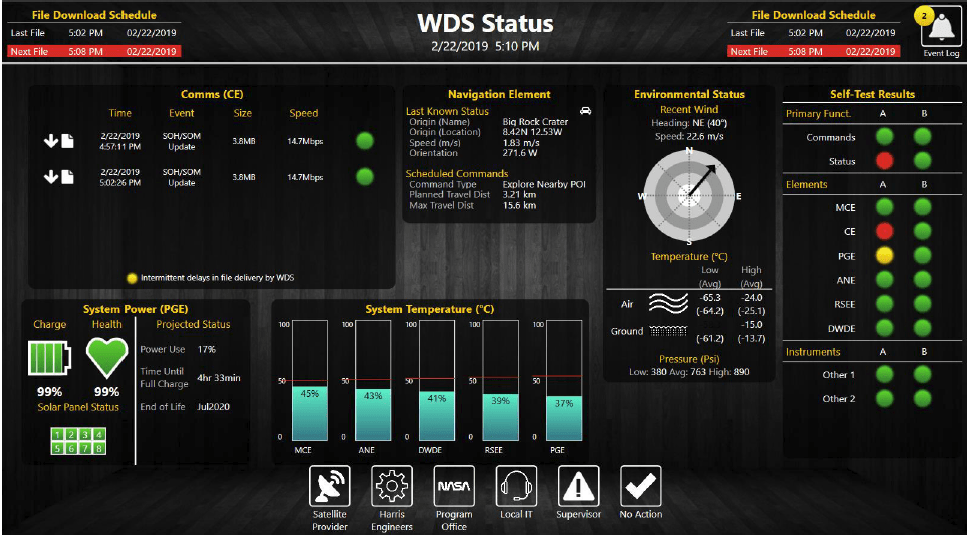
The second design incorporated the findings from the literature review, and it was designed to be a more useful, usable, and easily understood interface compared to the other designs. The interface design was completely overhauled to focus on making important information salient, supporting interface customization by users, and limiting extraneous information from the front page.

The third design was purposefully obtuse and sought to invert the recommendation proposed by the literature review. The design imitated the early 90’s aesthetic with a heavy focus on large amounts of text, a reduced amount of supplemental information pointers (i.e., multiple signals for a single event), minimal customization by users.
Phase 3: Experimentation
The final phase in this project was conducting a series of experiments using the test interfaces to improve our understanding of information processing for complex tasks. I met with engineers to develop functional requirements, designed a full experimental procedure from sign-up to debrief, and identified new avenues for future testing. Unfortunately, shortly after completing Phase 2, a L3Harris underwent a large reorganization and this project lost its funding source before experimentation could commence.

Summary
This project was a great experience and helped me learn how to work with Industry Stakeholders to meet their goals. I learned to build interfaces with Axure and PowerPoint, performed a deep research review to understand how to design interfaces that are purposefully designed to fit the cognitive mechanisms that we use to interact with a complex system.

 Oury Design